Collagenase (nonspecified subtype) Related Diseases

Related Diseases
1) Stroke
Cerebrovascular Disease, also known as cerebrovascular disorder, is related to basal ganglia cerebrovascular disease and stroke, ischemic, and has symptoms including headache, transient ischemic attacks, stereotypic symptoms and angina pectoris. An important gene associated with Cerebrovascular Disease is HOTAIR (HOX Transcript Antisense RNA), and among its related pathways/superpathways are Signal Transduction and Regulation of Insulin-like Growth Factor (IGF) transport and uptake by Insulin-like Growth Factor Binding Proteins (IGFBPs). The drugs Acetylcarnitine and Benzocaine have been mentioned in the context of this disorder. Affiliated tissues include brain, bone marrow and heart, and related phenotypes are homeostasis/metabolism and growth/size/body region
2) Arthritis
Arthritis, also known as inflammatory joint disease, is related to rheumatoid arthritis and juvenile rheumatoid arthritis, and has symptoms including arthralgia, back pain and metatarsalgia. An important gene associated with Arthritis is SYK (Spleen Associated Tyrosine Kinase), and among its related pathways/superpathways are Innate Immune System and MIF Mediated Glucocorticoid Regulation. The drugs Entecavir and Chlorhexidine have been mentioned in the context of this disorder. Affiliated tissues include joint, bone and bone marrow, and related phenotypes are Decreased Tat-dependent HIV-LTR-beta-galactosidase protein expression and homeostasis/metabolism
3) Asthma
Asthma, also known as chronic obstructive asthma, is related to allergic asthma and childhood-onset asthma, and has symptoms including recurring periods of wheezing, chest tightness and shortness of breath. An important gene associated with Asthma is IL13 (Interleukin 13), and among its related pathways/superpathways are Allograft rejection and Interleukin-4 and Interleukin-13 signaling. The drugs Fentanyl and Etomidate have been mentioned in the context of this disorder. Affiliated tissues include Lung, smooth muscle and skin, and related phenotypes are asthma and bronchoconstriction
4) Multiple Sclerosis
Multiple Sclerosis, also known as ms, is related to pediatric multiple sclerosis and autoimmune hepatitis, and has symptoms including back pain, headache and hemiplegia. An important gene associated with Multiple Sclerosis is HLA-DRB1 (Major Histocompatibility Complex, Class II, DR Beta 1), and among its related pathways/superpathways are Phosphorylation of CD3 and TCR zeta chains and Cell differentiation - expanded index. The drugs Acetaminophen and Promethazine have been mentioned in the context of this disorder. Affiliated tissues include Neural Tube and Limb, and related phenotypes are spasticity and diplopia
5) Influenza
Influenza, also known as flu, is related to avian influenza and swine influenza, and has symptoms including chills, fever and sore throat. An important gene associated with Influenza is IVNS1ABP (Influenza Virus NS1A Binding Protein), and among its related pathways/superpathways are Innate Immune System and Disease. The drugs Hops and Coal tar have been mentioned in the context of this disorder. Affiliated tissues include heart, t cells and brain, and related phenotypes are no effect and no effect
6) Rheumatoid Arthritis
Rheumatoid Arthritis, also known as ra, is related to arthritis and psoriatic arthritis, and has symptoms including back pain, muscle cramp and sciatica. An important gene associated with Rheumatoid Arthritis is PTPN22 (Protein Tyrosine Phosphatase Non-Receptor Type 22), and among its related pathways/superpathways are NF-kappaB Signaling and Genes associated with the development of rheumatoid arthritis. The drugs Entecavir and Alendronic acid have been mentioned in the context of this disorder. Affiliated tissues include Cartilage, joint and bone, and related phenotypes are joint stiffness and fatigue
7) Diabetic Macular Edema
Diabetic Macular Edema is related to vitreous detachment and retinal detachment. An important gene associated with Diabetic Macular Edema is VEGFA (Vascular Endothelial Growth Factor A), and among its related pathways/superpathways are Apoptotic Pathways in Synovial Fibroblasts and ERK Signaling. The drugs Dipivefrin and Diclofenac have been mentioned in the context of this disorder. Affiliated tissues include eye, endothelial and retina, and related phenotypes are homeostasis/metabolism and nervous system
8) Corneal Ulcer
Corneal Ulcer, also known as ulcerative keratitis, is related to conjunctivitis and pyoderma. An important gene associated with Corneal Ulcer is NGF (Nerve Growth Factor), and among its related pathways/superpathways are Innate Immune System and ERK Signaling. The drugs Amphotericin B and Prednisolone phosphate have been mentioned in the context of this disorder. Affiliated tissues include eye, bone marrow and endothelial, and related phenotypes are homeostasis/metabolism and immune system
9) Psoriasis
Psoriasis is related to psoriasis 7 and psoriasis 10, and has symptoms including exanthema, pruritus and psoriasiform rash. An important gene associated with Psoriasis is MIR203A (MicroRNA 203a), and among its related pathways/superpathways are miRNAs involvement in the immune response in sepsis and Cell differentiation - expanded index. The drugs Metformin and Vedolizumab have been mentioned in the context of this disorder. Affiliated tissues include skin, t cells and endothelial.
10) Osteoarthritis
Osteoarthritis, also known as osteoarthrosis, is related to cartilage disease and exostosis, and has symptoms including arthralgia, back pain and metatarsalgia. An important gene associated with Osteoarthritis is HOTAIR (HOX Transcript Antisense RNA), and among its related pathways/superpathways are ECM proteoglycans and Extracellular matrix organization. The drugs Fentanyl and Benzocaine have been mentioned in the context of this disorder. Affiliated tissues include Cartilage and Bone, and related phenotype is limbs/digits/tail.
11) Osteoporosis
Bone Mineral Density Quantitative Trait Locus 8, also known as osteoporosis, is related to osteoporosis and bone mineral density quantitative trait locus 15, and has symptoms including angina pectoris, back pain and muscle cramp. An important gene associated with Bone Mineral Density Quantitative Trait Locus 8 is BMND8 (Bone Mineral Density Quantiative Trait Locus 8). The drugs Clobetasol and Hydrocortisone have been mentioned in the context of this disorder. Affiliated tissues include bone, bone marrow and spinal cord.
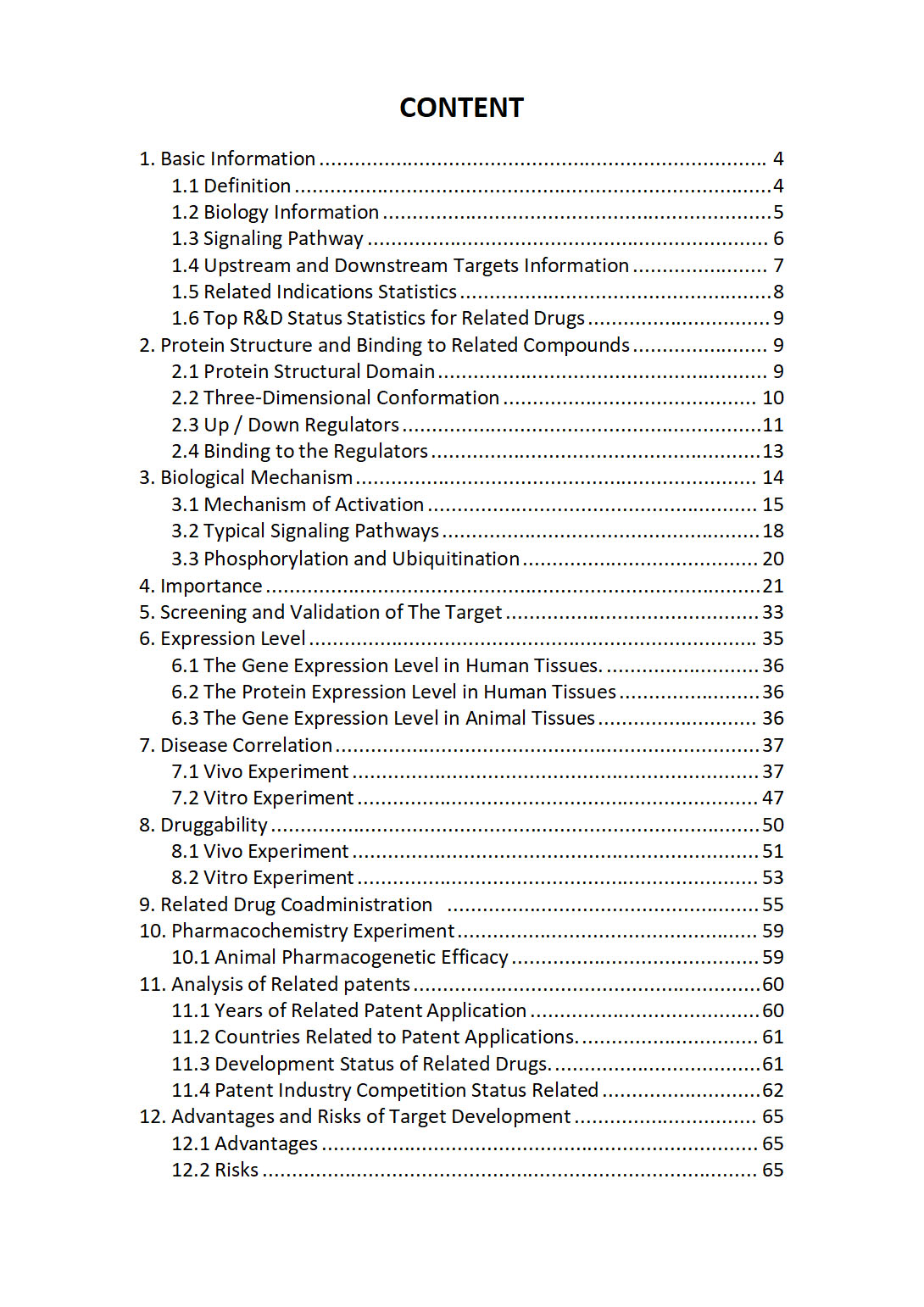
The "Collagenase (nonspecified subtype) Target / Biomarker Review Report" is a customizable review of hundreds up to thousends of related scientific research literature by AI technology, covering specific information about Collagenase (nonspecified subtype) comprehensively including but not limited to:
• general information;
• protein structure and compound binding;
• protein biological mechanisms;
• its importance;
• the target screening and validation;
• expression level;
• disease relevance;
• drug resistance;
• related combination drugs;
• pharmacochemistry experiments;
• related patent analysis;
• advantages and risks of development, etc.
The report is helpful for project application, drug molecule design, research progress updates, publication of research papers, patent applications, etc. If you are interested to get a full version of this report, please feel free to contact us at BD@bio.cacnex.com.
More Common Targets
11beta-Hydroxysteroid Dehydrogenase | 14-3-3 Protein | 15-Lipoxygenase | 17-beta-Hydroxysteroid dehydrogenase | 28S ribosomal subunit, mitochondrial | 3-Ketoacyl-CoA Thiolase (3-KAT) | 39S ribosomal subunit, mitochondrial | 4EHP-GYF2 complex | 5-Hydroxytryptamine Receptor | 5-Hydroxytryptamine Receptor 1 (5-HT1) | 5-Hydroxytryptamine Receptor 2 (5-HT2) | 60S Ribosome | 9-1-1 cell-cycle checkpoint response complex | A-Kinase Anchor Proteins | A1BG | A1BG-AS1 | A1CF | A2M | A2M-AS1 | A2ML1 | A2MP1 | A3GALT2 | A4GALT | A4GNT | AAAS | AACS | AACSP1 | AADAC | AADACL2 | AADACL2-AS1 | AADACL3 | AADACL4 | AADACP1 | AADAT | AAGAB | AAK1 | AAMDC | AAMP | AANAT | AAR2 | AARD | AARS1 | AARS2 | AARSD1 | AASDH | AASDHPPT | AASS | AATBC | AATF | AATK | ABALON | ABAT | ABCA1 | ABCA10 | ABCA11P | ABCA12 | ABCA13 | ABCA17P | ABCA2 | ABCA3 | ABCA4 | ABCA5 | ABCA6 | ABCA7 | ABCA8 | ABCA9 | ABCB1 | ABCB10 | ABCB11 | ABCB4 | ABCB5 | ABCB6 | ABCB7 | ABCB8 | ABCB9 | ABCC1 | ABCC10 | ABCC11 | ABCC12 | ABCC13 | ABCC2 | ABCC3 | ABCC4 | ABCC5 | ABCC6 | ABCC6P1 | ABCC6P2 | ABCC8 | ABCC9 | ABCD1 | ABCD2 | ABCD3 | ABCD4 | ABCE1 | ABCF1 | ABCF1-DT | ABCF2 | ABCF3 | ABCG1 | ABCG2

CONTACT
BD@bio.cacnex.com
2026© Cacnex Consulting Ltd. All Rights Reserved
